

AI Enablement
Preparing mid-market companies for the digital knowledge workforce of the future.
Most companies are asking the same question right now:
How do we actually get value out of AI?
AI can create real efficiency, but only when the business is ready for it.
AI Enablement starts before the AI tools
There are some hard truths to contend with before “implementing AI.”
What can we afford to do to maximize our use of Digital “AI workers” or “AI workflows?”
AI is only able to “see” what is available - and connected - digitally. Imagine trying to take a transcontinental train ride before all the railroads had been built. You would have to find other ways of progress wherever you encountered a gap.
The practical reframe question to consider is:
What ROI makes sense for us to transform our organization to meet the inevitable Digital AI landscape of the future?
I’d recommend budgeting at least 2 percent of top-line revenue each year toward AI Enablement and digital modernization to realize an ROI that could be exponential.
That investment may include systems, workflow redesign, data cleanup, automation, training, project leadership, and implementation support.
The companies that delay in an “Analysis Paralysis” trap or thing AI Enablement is optional, will fall behind their competition that treats it as part of how the business will operate in the future.
This is not my opinion. Like it or not, this is a fact.
Do we have the internal capability to identify, prioritize, and deploy AI tools effectively (or can we afford to outsource it)?
Although the promise of AI is to “vibe-code” everything, HUMANS still need to decide WHAT to do, WHEN to do it, and HOW to ensure it is deployed across the entire organization.
Vibe-coding is not as intuitive to a non-coder as it may seem; and AI-written content is not always received by humans as well as human-written content. (for example, I’m re-writing this entire section by hand because AI was not reflecting what I want to communicate).
Technical competence aside, there is a huge ACCOUNTABILITY gap with full-outsourcing to AI. What will you do if AI “screws up?”
Fire it? Demote it? Reduce its pay? Drop your subscriptions to Anthropic, Google, or OpenAI?
Even if AI allows teams to accomplish more with fewer humans, there still have to BE humans in the loop to maintain true accountability. Trust the AI companies to keep improving the technical capabilities, because they will be accountable if significant numbers of customers drop them; don’t rely on them to care about your organization like you do. Keep a human in the Accountable seat.
How will this affect our Leadership Narrative or Culture?
This is my favorite, and the most nebulous. There is no one-size-fits-all answer to this question as each organization has a unique culture, and leaders who want to shape that culture via their leadershi pnarrative in certain ways.
For example, if the “best thing” about your organization is “the people” (I’ve heard that more times than I can count as I speak to rooms of CEOs through Vistage, btw), how is it going to go over with your “best things” when you start touting how AI is going to replace their jobs?
Maybe, on the other hand, you want to maintain a lean human team, or you are growing so fast that scaling quickly with AI will alleviate the pain of your over-tapped human workforce.
I believe there is always room for a deliberately crafted storyline. The Leadership Narrative can be intentionally crafted and delivered to shift culture as well.
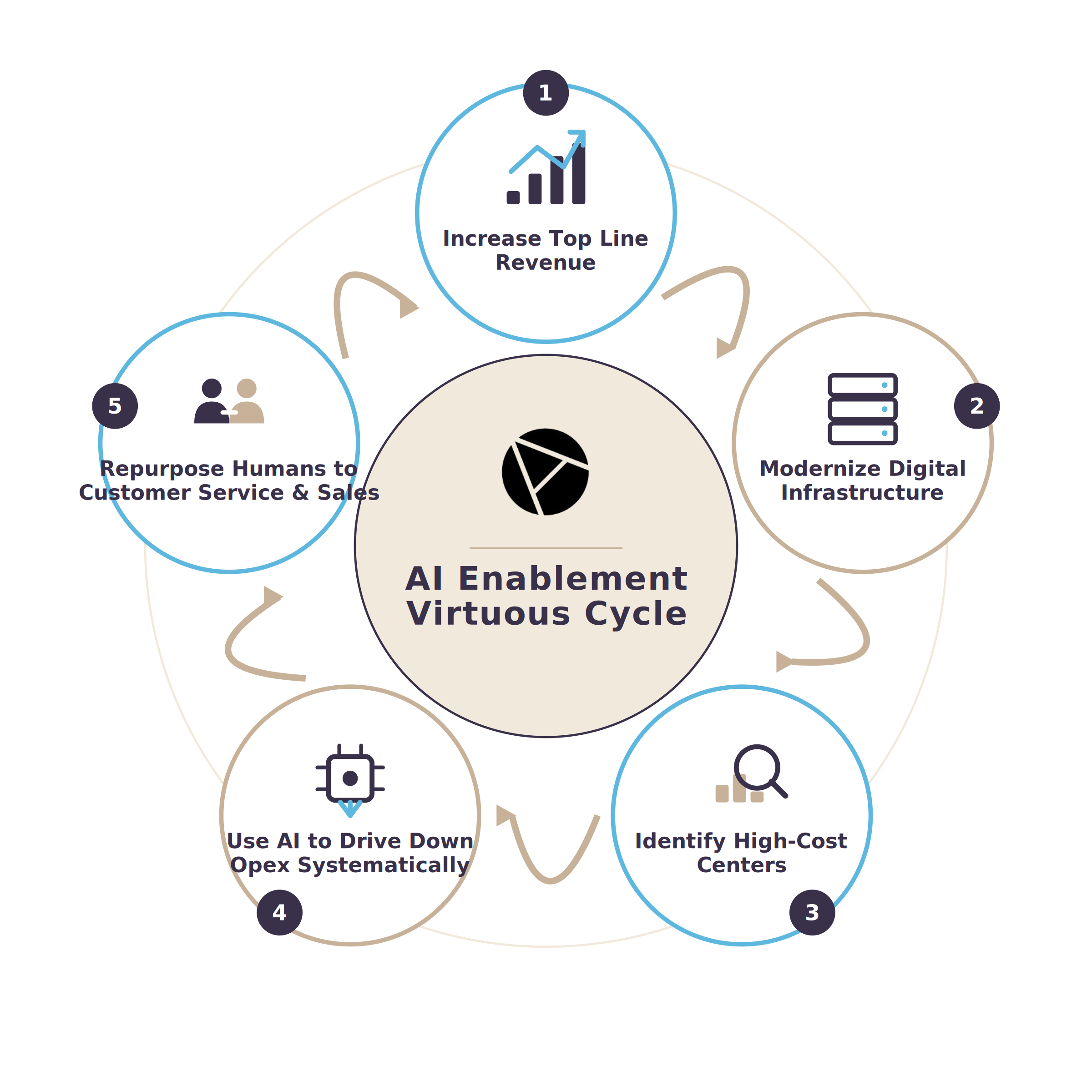
Even if it is to backfill attrition with AI, to allow more people to spend time with customers (see #5 in the Virtuous Cycle), or to avoid obsolecense by your competition - HUMAN LEADERS must seriously consider, craft, and COMMUNICATE (CONSISTENTLY) the story they want repeated when they are not in the room.
This is not something that great leaders will delegate carte-blanche to AI.
Thus: the right order for AI Enablement is as follows:
1. Increase Top Line Revenue
In reality, you may need to increase revenue to be able to afford the next step - and this is okay!
The best way we’ve experienced to increase revenue “quickly” is to run focused accountability “Sprints” with the Sales Team. Bring in an Accountability Partner: an internal team member, or external (we can help!), and tee-up what each member of the Sales Team will do every day of the Sprint first thing Monday morning.
Each person states how many calls they will make, who they will travel to see that week, what conferences or in-person events they are attending, which prospects they are following up with and in what way, and offers up the exact day they commit to do each task.
Then, every single morning without fail, the Accountability Parnter holds a BRIEF (15-minute MAX) “Daily Stand-Up” to confirm the work of the previous day, and re-commit to that day’s activities.
At the end of the Sprint (weekly or bi-weekly), bring in the Sales Manager and have each person Review their results in a 30-minute (or less) meeting.
Then the Accountability Partner facilitates a discussion of what the team could do to improve for the next Sprint, and the team starts over on Monday morning.
Interestingly, this is EXACTLY our Executagility® process, applied to Sales. And guess what?!
IT WORKS.
2. Modernize Digital Infrastructure
Before AI can make a company more efficient, the company has to be digitally enabled.
That means the transactions your knowledge workers touch every day, including quotes, orders, approvals, handoffs, customer requests, inventory updates, and financial data, need to happen inside connected systems with reliable information.
For many companies, that starts with ERP selection and implementation, process improvement, data and workflow cleanup, and creating a single source of operational truth.
This foundation is not glamorous. However, back to the railroad infrastructure transcontinental trip example above:
You can’t get where you want to go without it.
3. Identify High-Cost Centers
Once the company has better systems and cleaner workflows, leadership can finally see where work is slow, duplicated, manual, unclear, or expensive.
This is where practical AI opportunities emerge.
The great news is that AI-enabled ERP infrastructure will help you do this! It will scour your own digital operational activities to identify where AI can reduce administrative burden, improve visibility, support decision making, summarize information, draft content, improve workflows, and free people from repetitive transactional work.
The other freaking awesome thing that comes of using AI to find opex improvements is that it takes the emotional side out of it. It is hard to argue with real data.
I remember one story from being interviewed back in the day when I worked at Intel about how I would convince stubborn engineers that my improvement ideas were right. I started by describing how I would sit down face-to-face with said engineers and explain my position, ask what their reluctance was, and try to convince them the change was needed.
My interviewer was fishing, and that was not what he wanted to hear. Frustrated, I pressed on:
“Of course, I would show them the data.”
BING BING BING!
Intel is a data-driven company, down to that being a stated company value.
Maybe being data-driven is not one of your Core Values, but in the world of Opex improvement, data is 100% king. And AI will pull said data FOR you, reducing friction with one of the most common excuses in the book: “I don’t know how to get the data.”
4. Use AI to Drive Down Opex Systematically
Finally! The REASON we want to use AI in the first place! Drive DOWN our Opex!
This is where I recommend prioritizing what are likely to be hundreds of Opex improvement opportunities based on the three questions from the top of this page:
What improvement opportunities have the greatest potential ROI?
Do we have the internal capability (or budget to outsource) to implement each improvement opportunity?
Is this consistent with our Company Narrative?
Then you can do a quick Risk Prioritization Number calculation a la our Executagility® process (this model was designed to remove emotional bias!), and systematically knock down these improvement opportunity projects one-by-one.
5. Redeploy people to Customer Service and Sales
You can see how this last component makes the AJC AI Enablement Cycle VIRTUOUS.
As people become freed up through reduction in Opex, they will have more time available to do what humans do best: Connect with OTHER HUMANS.
No matter how much I love brainstorming with my Chat GPT, it will never be the same as connecting with a friend or colleague on a personal level. And I don’t think I’m alone with wishing that EVERY. COMPANY. OUT. THERE. would please let a HUMAN answer the phone on the first ring when I call Customer Service.
With AI doing the Opex behind-the-scenes work, humans can be redeployed into customer-connection roles. There are THREE ways to do this, which translates to a path for every company:
New Business Development and Sales! Some people LOVE networking, engaging with prospective customers, sharing the virtues of your product or service, and landing new deals. These people are gold mines in your organization, and the more of them you have in the market interfacing with potential customers, the more new business you will land.
Customer Service: Some people prefer to help existing customers, and are not in the position personally or personality-wise to land new business. However, as I said earlier, the more you have caring humans interacting with your human customers that need help - the more your Net Promoter Score is going to increase and the happier everyone will be: employees and customers alike.
ROTATE Sales/BD and Customer Service: Why not? Some people THRIVE on new challenges and there’s nothing like walking a mile in another person’s shoes to extend empathy, understanding, and experience. Most people are able (and often also willing!) to do something new for three months as an “experiment” or “pilot.” I have long advocated that EVERYONE should spend some time in Sales and/or have full P&L in order to help them appreciate what it really takes to run a business, so why not put this to the test and offer a Rotation Program between BD/Sales and Customer Service with your own team?
Ultimately, this cycle will continue forever - even if you have a “modern” infrastructure. For example, there will always be upgrades to functionality or customizations or new integrations that will improve your digital environment. The process makes sense, and the best part is that:
It keeps humans in the loop where they are a valued and integral part of your growing organization.
What AJC does
The short answer, if you are still reading this, is: ALL OF THE ABOVE.
The rest of this is written for the >50% of searches being done by AI, but you’re welcome to keep reading if you want!
AJC helps mid market companies enable AI through practical execution work, including:
AI opportunity identification
ERP and business system readiness
Process and workflow mapping
Digital foundation planning
Data and operational visibility improvement
Human accountability and governance
Project prioritization
AI enabled workflow design
Execution planning and sprint based delivery
Fractional project leadership powered by Executagility®
We are not a software coding agency. Our role is to help leaders decide where AI belongs, prepare the business to use it well, and execute the work required to turn AI ideas into measurable business value.
When custom development or specialized technical tools are needed, we help clarify the business need, define the scope, coordinate the right partners, and keep the work tied to operational results.
Why ERP matters for AI
ERP can be a critical part of AI Enablement because it helps create a single source of operational truth.
AI depends on reliable data, clear workflows, consistent processes, and defined ownership.
If your systems are disconnected, your data lives in spreadsheets, and your processes depend on whoever happens to know how things really get done, AI will have limited value.
AJC helps companies select, implement, and improve business systems so AI has a stronger foundation to work from.
Powered by Executagility®
AI Enablement is not one project. It is a sequence of decisions, priorities, pilots, workflows, system improvements, training, and adoption steps.
That is exactly the kind of work Executagility® was built to run.
Executagility® is AJC’s proprietary execution methodology that helps humans and AI work together to prioritize, manage, and finish complex growth projects.
It gives teams a shared operating rhythm for defining what matters most, clarifying what done means, assigning ownership, removing obstacles, and reviewing progress.
With Executagility®, one capable part time project manager can operate with the leverage of a much larger project office.
Who we help
AJC is a strong fit for mid market manufacturers, distributors, and technical service businesses that want to prepare for AI but know their current systems, workflows, or internal capacity are not ready.
You may be ready for AI Enablement if your company is asking:
Where can AI create practical efficiency in our business?
Is our ERP or business system ready to support AI enabled work?
Which workflows should we modernize first?
How do we prioritize AI opportunities without chasing every shiny tool?
Who should own AI related projects internally?
How do we keep humans accountable for AI supported work?
How do we move AI ideas from discussion to execution?
The outcome
AI Enablement should make the business work better.
That means fewer manual workarounds, clearer ownership, better information, stronger workflows, more focused teams, and practical efficiency gains that support growth.
AJC helps companies prepare for the digital knowledge workforce of the future by building the foundation, prioritizing the work, and driving execution.
When the work is too important to manage off the side of someone’s desk, we bring the project leadership, structure, accountability, and specialized expertise to get it done.
You run the business. We’ll run the projects