
AJC Rookies Research Results: Is There a Market for Professionally Managed Student Project Teams?
The Question Behind the Research
This summer, AJC Company set out to test a practical question: is there real local market interest in professionally managed “tiger teams” of high school graduates, late high school students, and early college students completing focused project work for businesses?
The idea came from a real problem on both sides of the equation. Students often want meaningful work experience, but traditional summer jobs can be hard to fit around sports, family travel, retreats, college preparation, and other commitments. Businesses, meanwhile, often have important projects they would like to complete, but not enough internal bandwidth to scope, train, manage, and oversee short-term help.
AJC already operates a fractional, project-based model for mid-market manufacturers, distributors, and technical field service companies. AJC Rookies explores whether a lower-fee, youth-staffed version of that same model could help local businesses get useful work done while giving students meaningful professional experience.
Below is a video slideshow of the results for you to enjoy!
How the Research Was Conducted
Lucia Jones conducted 23 interviews with Central Florida business leaders across seven industries. Seventeen interviews were conducted in person and six were conducted virtually. Each conversation averaged 20 to 30 minutes and followed a five-part structure: business background, current opportunities and challenges, openness to professionally managed student project work, reactions to specific project ideas, and possible next steps.
The interview group included companies in construction, professional services, manufacturing, banking, technology, entertainment, and agriculture. Construction and professional services represented the largest groups, with seven companies each, followed by manufacturing, banking, technology, entertainment, and agriculture.
The Short Answer: Yes, There Is Interest
The research finding was clear: there appears to be real market interest in the AJC Rookies concept.
At least 19 of the 23 interviewees responded positively or conditionally positively to the idea of professionally managed student project teams. Several companies already use interns, co-op students, or adjacent early-career talent models and saw AJC Rookies as a natural extension of something they already value.
Importantly, the hesitation that did surface was not usually about whether young people are capable. The more common concern was whether the business could identify a clear, low-context project and avoid taking on the burden of training and supervision. That is a project design challenge, not a hard market rejection.
One of the strongest framings that emerged from the interviews was the idea of AJC acting as a “broker model”: a trusted conduit between vetted student talent and a specific business need. That language is useful because it makes the value clear. The business is not simply “hiring a student.” It is accessing a professionally scoped and managed project resource.
What Businesses Are Focused on Right Now
The interviews revealed several recurring business opportunities and challenges across industries.
The most frequently cited category was AI adoption and internal efficiency, with 12 of 23 companies citing it. Leaders are not only curious about AI; many are already using it for administrative tasks, research, presentations, workflow support, content creation, internal tools, and decision support.
Talent acquisition and retention was the second-largest theme, cited by 9 of 23 companies. This came through strongly across industries, especially in construction, trades, services, and other people-intensive businesses.
Capacity and management bandwidth, product and service innovation, and sales and business development were also major themes. In plain English: businesses have plenty of ideas, but not always enough time, ownership, or execution support to move those ideas forward.
AI Is a Live Business Issue, Not a Buzzword
One of the strongest findings was how consistently AI showed up in the conversations. Some leaders described AI as already embedded in daily work. Others were experimenting cautiously. A few were skeptical or concerned about confidentiality, values, cost, or overuse.
That range matters. The market is not simply “AI enthusiastic” or “AI resistant.” It is practical, curious, cautious, and uneven. That creates an opportunity for well-scoped AJC Rookies projects that help companies research, organize, test, or document practical AI use cases without turning AI into a giant, vague transformation project.
AI-search visibility also emerged as a meaningful theme. Several leaders recognized that companies may need to think beyond traditional SEO and understand how they show up in tools like ChatGPT, Claude, Gemini, Perplexity, and other AI-driven search environments.
Which AJC Rookies Project Ideas Resonated Most
The project ideas with the strongest response were practical, focused, and easy for business leaders to imagine.
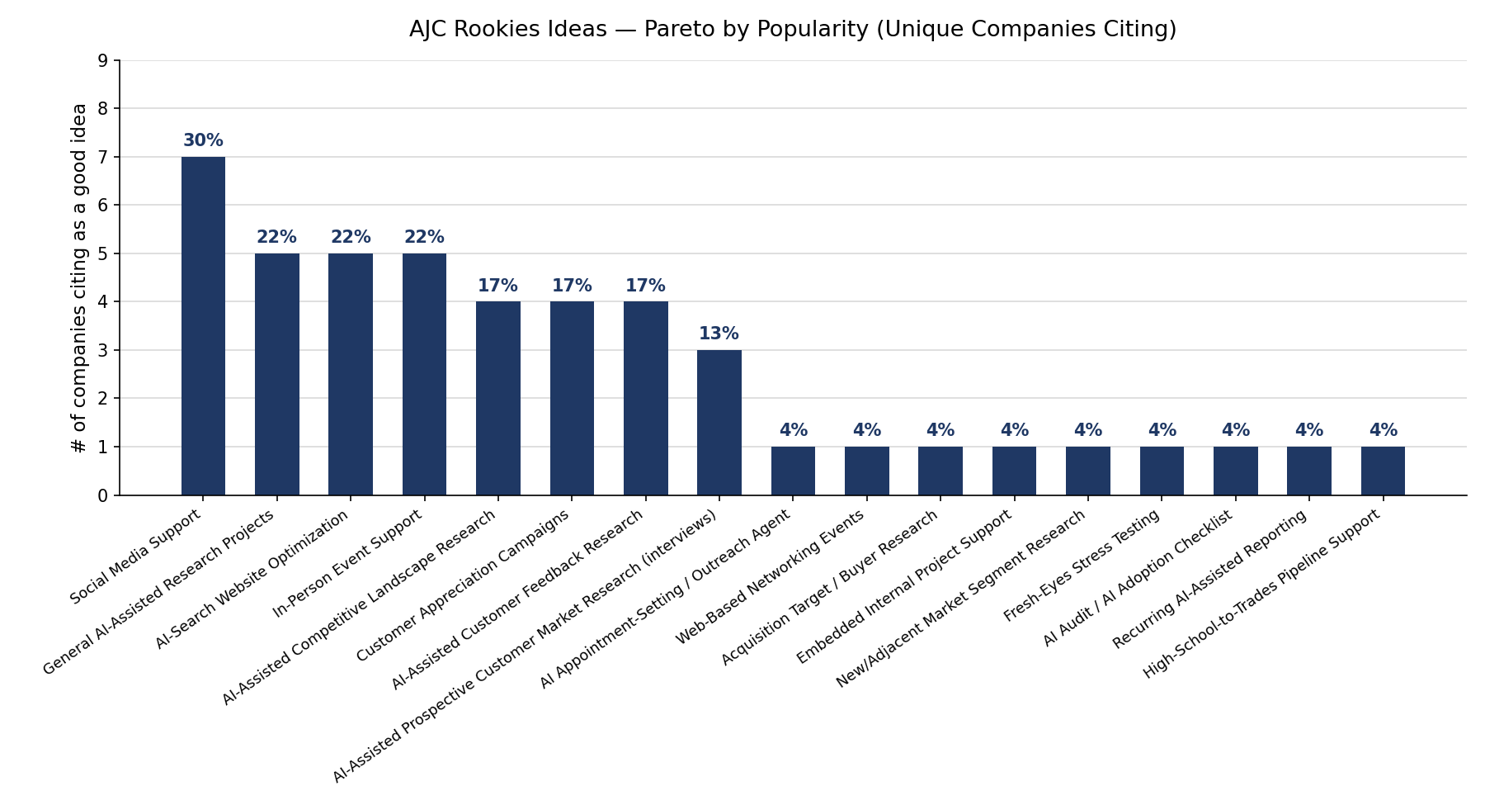
Social Media Support was the most popular idea, cited positively by 7 of 23 companies. However, “social media” meant different things depending on the industry. For professional services companies, it often meant marketing visibility and customer communication. For construction and trades-related companies, it often connected more directly to recruiting, workforce pipeline, and employer brand.
Three ideas tied closely behind: General AI-Assisted Research, AI-Search Website Optimization, and In-Person Event Support, each cited by 5 companies. Competitive Research, Customer Appreciation Campaigns, and Customer Feedback Research also received meaningful interest.
The strongest ideas were not “make-work” projects. They were business-useful projects that could produce a clear deliverable: a report, content calendar, customer feedback summary, competitive landscape, event support plan, website recommendations, or outreach list.
The Best Ideas Came from the Interviewees
Some of the most credible project ideas did not come from AJC’s original list. They came directly from the business leaders during the interviews.
New ideas included an AI appointment-setting or outreach agent, acquisition target or buyer research, an AI adoption checklist, recurring AI-assisted reporting, fresh-eyes website or process testing, embedded internal project support, web-based networking support, and a high-school-to-trades pipeline project.
That is an important result. It means the market did more than react to AJC’s original concept. Interviewees began shaping the model themselves.
The Main Barrier Is Not Student Capability
The biggest recurring concern was not, “Can students do useful work?” The bigger concern was, “Who will train them, manage them, and make sure the work is actually useful?”
That is the key design requirement for AJC Rookies.
The pitch should not lead with how impressive the students are, even if they are. It should lead with how AJC removes the management burden: project scoping, student selection, expectations, oversight, progress tracking, and final deliverables.
Businesses are more likely to say yes when they are buying a defined project outcome, not taking on another person to supervise.
What Comes Next
The recommended next step is to pilot the model with two or three enthusiastic businesses that have clear, specific project needs. The best early pilots should be tightly scoped, easy to explain, and designed to produce visible outcomes.
The leading pilot categories are likely to include social media support, AI-assisted research, AI-search website optimization, in-person event support, competitive research, customer appreciation, and customer feedback research.
AJC Rookies does not need to become everything for everyone. The opportunity is to package a small number of high-value, repeatable project types that businesses can understand quickly and students can complete well with professional oversight.
Why This Matters
AJC Rookies sits at the intersection of three real needs: students need meaningful professional experience, businesses need help completing focused projects, and local communities need better bridges between education and work.
The research suggests there is a real opportunity here, but only if the model is structured well. Students need clear expectations. Businesses need low-friction engagement. AJC needs to provide the professional layer that turns student effort into business value.
That is the heart of the model: young talent, real projects, professional oversight, and useful outcomes.
The research says the idea is worth piloting.
