
Working Genius and Project Management: Building Better Project Teams
If you've worked with me for any period of time, you probably know that I LOVE The Six Types of Working Genius.
(sidebar, I have a signed copy from Patrick Lencioni because I submitted a question to the “At The Table” podcast that he used in November of 2022. :-)
I've written before about how Working Genius shows up in change management. But there's another place where I see it constantly:
Project management.
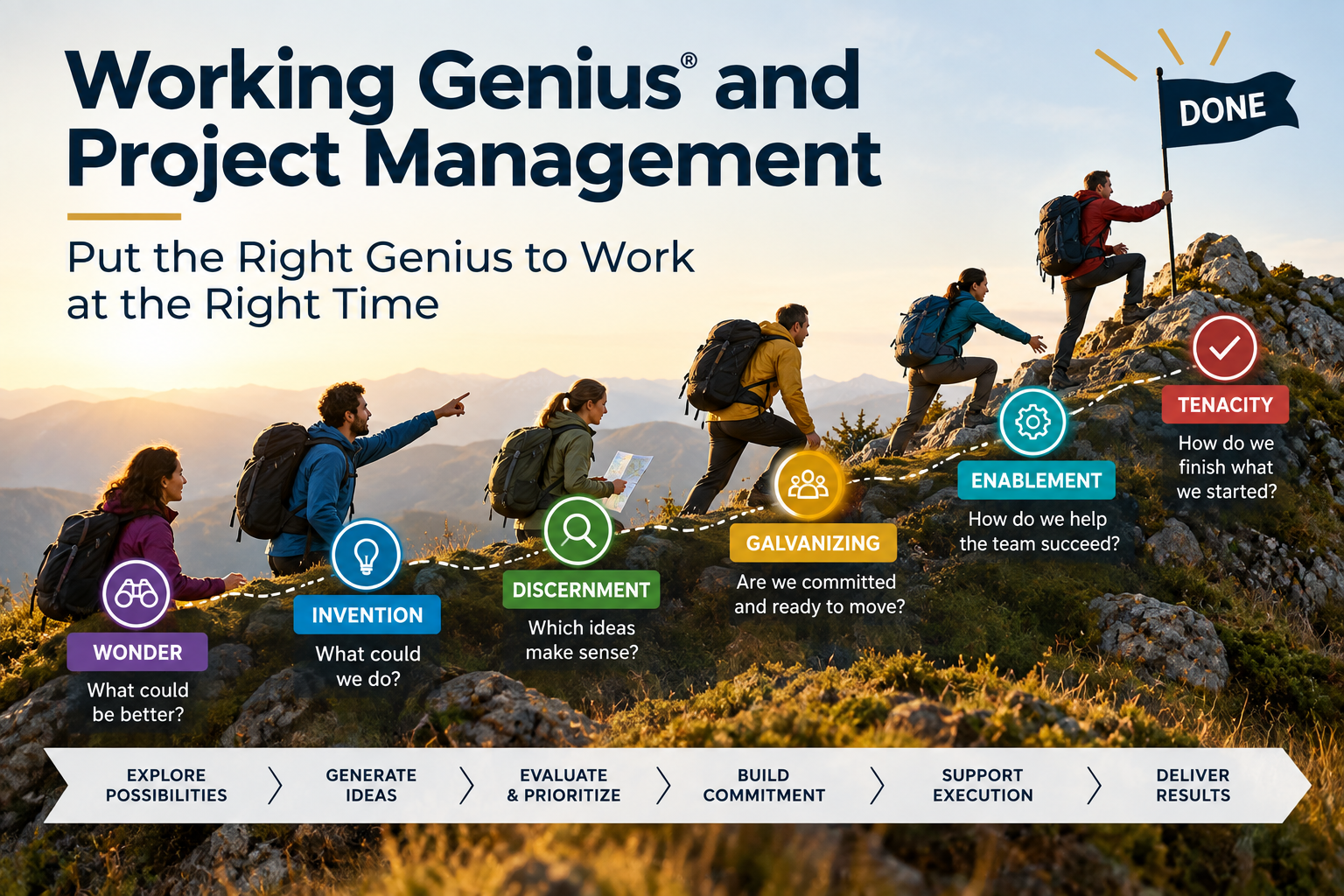
Projects require all six Working Geniuses—Wonder, Invention, Discernment, Galvanizing, Enablement, and Tenacity.
But they don't require them all at the same time.
And that's where I think project teams can get themselves into trouble.
Start With Wonder and Invention
Every good project starts with some version of:
What could be better?
That's where your Wonder and Invention people can be incredibly valuable.
Bring them into future-state mapping. Let them question the status quo. Let them imagine what's possible. Let them brainstorm better processes, better systems, better customer experiences, and better ways of working.
Your Invention people—the shiny-object/squirrel people among us—will have ideas. Lots of them.
They're often founders, CEOs, visionaries, or other leaders who naturally see possibilities and then rely on other people to turn those possibilities into reality.
At this stage of a project, that's a feature.
Later, it can become a problem.
Then You Need Discernment
Not every good idea should become a project.
And not every idea that makes it into a project belongs in the final solution.
That's where Discernment becomes so important.
Discernment asks:
Does this actually make sense?
Will it work here?
What are we missing?
Is this the right solution—or just an interesting one?
The trick is timing.
If you're strong in Discernment or Tenacity, the brainstorming session isn't necessarily the moment to explain all 17 reasons an idea won't work.
Let the possibilities breathe a little.
Then use Discernment to filter them.
The goal isn't to pop every bubble. It's to determine which bubbles are worth turning into something real.
Be Careful With Your Galvanizers
This one I know from experience.
Galvanizers LOVE getting people moving.
Once we see an idea we believe in, our instinct is:
This is great. Let's GO.
If you're an Invention/Galvanizing combination like I am, there's an additional risk.
You can invent something at 9:00, get everyone excited about it by 10:00, and have people working on it before lunch.
Sometimes that's a superpower.
Sometimes it's how organizations end up with 37 priorities.
In fact, a big part of what eventually became the Executagility® Model was me creating a structure that forced myself to discern, prioritize, and pace idea activation.
Because generating energy isn't the same thing as determining whether something deserves organizational capacity.
A project needs a deliberate point where we decide:
Yes. This idea has been sufficiently considered. We are committing to execute it.
Then unleash the Galvanizers.
Enablement Helps Turn Momentum Into Action
Once the direction is clear and the organization is actually ready to move, your Enablement people become invaluable.
They're ready to help.
They respond to what the team needs. They support the people doing the work. They help remove barriers and keep the organization moving together.
This is also why activating a project too early can create so much wasted energy.
If the Invention/Galvanizing crowd gets everyone mobilized before the project has been adequately discerned, scoped, and prioritized, helpful people can spend a lot of time executing something the organization hasn't actually decided to do.
Enthusiasm is not the same thing as commitment.
And Then, Thank Goodness, There Is Tenacity
Eventually, somebody has to finish the thing.
Testing.
Validation.
Data cleanup.
Documentation.
Training completion.
Issue resolution.
Closing open items.
Getting from 92% done to DONE.
This is where Tenacity is priceless.
And it is also where I'd be very careful about how heavily you rely on your Wonder and Invention people.
Because when you're validating the solution and putting on the finishing touches, the last thing you necessarily need is:
“WAIT! What if we did it THIS way instead?”
No.
We had that meeting six months ago.
Your Wonder/Invention people can unintentionally pull the team all the way back up to the top of the project when everyone else is desperately trying to land the plane.
There will always be another good idea.
Capture it.
Put it in the parking lot.
Finish this project.
Don't Build Every Project Team the Same Way
Working Genius gives us a useful lens for something I've observed across decades of projects:
The people who are exceptional at imagining a project aren't necessarily the people who should finish it.
And the people who are exceptional at finishing may be miserable if you ask them to spend weeks imagining every possible future state.
That doesn't make one person more valuable than another.
It means the project needs different kinds of genius at different moments.
Think about the natural progression:
Wonder → Invention → Discernment → Galvanizing → Enablement → Tenacity
What could be better?
What could we do?
Which ideas make sense?
Are we committed and ready to move?
How do we help the team succeed?
How do we finish what we started?
Real projects aren't perfectly linear, of course. You'll cycle back. You'll discover things. You'll need another round of discernment. Different people will contribute throughout.
But the underlying principle holds:
Don't just ask whether you have the right people on the project. Ask whether you're using their genius at the right time.
And perhaps most importantly, don't mistake someone's frustration with a particular phase of a project for a lack of commitment.
Your inventor may be bored during testing.
Your Tenacity person may want to scream during the third brainstorming session.
Your Galvanizer may be ready to launch while your Discernment person is still asking questions.
That's not necessarily dysfunction.
That's information.
A good project leader knows how to use it.
Because great project execution isn't about getting everyone to work the same way.
It's about getting the right genius working on the right problem at the right time—and then actually finishing what you started.
