
The Complete Guide to ERP Selection
How to Choose the Right ERP System and Software or Developer Partner — Without Wasting a Year or Millions of Dollars
AJC Company helps manufacturing, distribution, service, and multi-site organizations select and implement ERP systems, manage change, and execute strategic initiatives through Fractional PMO leadership. Unlike software vendors, AJC is vendor-neutral and does not accept kickbacks from ERP providers.
“We don’t want something worse than what we already have.”
- Mid-market President & CEO
Prefer to read this later? Download the Complete Guide to ERP Selection →
Selecting a new Enterprise Resource Planning (ERP) system is one of the biggest operational decisions a growing company will make.
Get it right, and the new ERP can give your team better information, eliminate manual work, support growth, improve visibility across departments, and provide a technology foundation that lasts for years.
Get it wrong, and you may spend hundreds of thousands—or millions—of dollars implementing a system that makes your business harder to run.
The good news: there is a structured way to select an ERP.
At AJC®, we help companies select and implement ERP systems. We don't sell ERP software, and we don't accept commissions or referral fees from software vendors. That matters because our job during ERP selection isn't to convince you to buy a particular product. It's to help you understand what your business actually needs, evaluate your options objectively, and make a decision your team can successfully implement.
This guide explains how.
ERP Selection Guide: Quick Navigation
Considering a change?
What is an ERP system?
How do I know if my company needs a new ERP?
What if our current ERP isn't actually the problem?
Should We Choose a Traditional ERP or Build a Custom System?
When should we start the ERP selection process?
Preparing for ERP selection
Who should be on the ERP selection team?
Should we map our processes before selecting software?
How do we identify ERP requirements?
How much time will our employees need to commit?
Do we need an ERP selection consultant?
Evaluating ERP systems and vendors
What does the ERP selection process look like?
How many ERP systems should we evaluate?
How should ERP demonstrations be conducted?
How do we compare ERP systems objectively?
How important is the implementation partner or VAR?
What questions should we ask ERP vendors?
How do integrations and customization affect the decision?
How should AI factor into ERP selection?
Making the decision
How long does ERP selection take?
How much does ERP selection cost?
What should happen before signing an ERP contract?
What are the biggest ERP selection mistakes?
Which ERP is right for a $25M, $50M, $100M or $250M company?
Preparing for implementation
What is the difference between ERP selection and implementation?
How do we prepare for ERP implementation?
How long does ERP implementation take?
What should we do about our data?
What happens after we select the ERP?
What Is an ERP System?
ERP stands for Enterprise Resource Planning. An ERP is a business system that connects many of the core transactions and information your organization uses to operate.
Depending on the system and your business, that may include:
Accounting and financial reporting
Sales and order management
Purchasing
Inventory
Manufacturing or production
Warehousing
Project or job costing
Customer information
Service
Supply chain
Human resources
Reporting and analytics
The important word isn't really enterprise. It's integrated.
Growing companies often reach a point where information is scattered across accounting software, spreadsheets, databases, CRM systems, warehouse systems, homegrown applications, and the heads of long-tenured employees.
An ERP can bring much of that information and workflow together.
But that doesn't mean the ERP should do everything.
A modern technology environment may still include specialized applications for CRM, ecommerce, field service, payroll, business intelligence, engineering, or other functions. The question isn't, “Can we put absolutely everything into one system?”
The better question is:
What technology environment will allow our business to operate effectively, scale appropriately, and maintain reliable information without unnecessary complexity?
Sometimes the answer is one ERP.
Sometimes it is an ERP plus several integrated systems.
And sometimes the answer is not replacing your current ERP at all.
How Do I Know If My Company Needs a New ERP?
Common warning signs include:
Employees rely heavily on spreadsheets and manual workarounds.
People enter the same information into multiple systems.
Leadership struggles to get reliable, timely reporting.
Your current system doesn't integrate well with other important applications.
Employees have created unofficial processes outside the system.
Your business has outgrown software originally selected for a much smaller company.
The system is difficult or expensive to maintain.
The technology is approaching end-of-life or losing vendor support.
Critical knowledge about the system resides with one or two people.
New locations, products, acquisitions, channels, or business models are difficult to support.
Employees are increasingly frustrated with the system.
Your current technology is constraining growth.
We've worked with companies still operating decades-old systems and others using relatively modern software that simply wasn't implemented well.
The age of the software isn't the deciding factor.
The real question is whether your current technology can support the business you are becoming.
What If Our Current ERP Isn't Actually the Problem?
This is one of the most important questions you can ask.
A frustrating ERP does not automatically mean you need another ERP.
Sometimes the real problem is:
Poor processes
Inadequate training
Bad data
Weak reporting
An incomplete original implementation
Missing integrations
Excessive customization
Lack of process ownership
Employees not using existing functionality
A few specific technology gaps rather than a system-wide problem
New AI capabilities add another possibility. In some situations, organizations may be able to improve reporting, automate specific workflows, or create targeted tools around their existing technology rather than replacing the entire system.
That is one reason AJC starts with current-state and future-state process mapping rather than immediately shopping for software.
If the evidence says you can keep your current ERP and improve the environment around it, that is a successful ERP evaluation too.
Don't spend $1 million solving a $100,000 problem.
Should We Choose a Traditional ERP or Build a Custom System?
For most mid-market companies, a proven ERP should still be the starting point—but custom software is becoming a much more viable option for specific business needs.
Traditional ERP systems have a major advantage: they already handle thousands of business requirements that aren't unique to your company. Accounting, purchasing, inventory transactions, security, audit trails, tax considerations, reporting structures, and other foundational capabilities have been developed and tested across many organizations.
Building all of that from scratch rarely makes sense.
But that doesn't mean every company should force every process into a traditional ERP.
Custom development may deserve serious consideration when:
Your business has processes that genuinely differentiate you from competitors.
Available ERP systems require extensive customization to accommodate your core operating model.
A specific workflow is poorly served by available commercial software.
You have strong internal technology leadership and the ability to maintain what you build.
A custom application can complement an ERP rather than replace the entire system.
Modern development tools and AI make a targeted solution significantly faster and less expensive to create than it would have been historically.
The key distinction is between commodity processes and differentiating processes.
There is usually little competitive advantage in custom-building your own general ledger, accounts payable, purchasing engine, or basic inventory transaction system. Mature ERP platforms already solve those problems.
But if your company has a unique way of quoting, configuring products, scheduling work, serving customers, managing projects, or making decisions—and that process creates real competitive advantage—forcing it into an ERP's standard workflow may not be the best answer.
Increasingly, the right technology strategy may be both:
Use a proven ERP as the system of record for standard business processes, while using custom applications, automation, integrations, and AI to support the processes that make your business different.
Before deciding to build, however, ask some hard questions:
Are we truly unique, or do we just think we're unique?
Does this process create measurable competitive advantage?
Is there existing software that already solves 80–90% of the problem?
What will it cost to build—not just initially, but over its lifetime?
Who will own, support, secure, document, test, and improve it?
What happens when the person who built it leaves?
How will it integrate with our ERP and other systems?
Are we prepared to become, in some small way, a software company?
AJC Recommendation: Don't frame the decision as “ERP or custom?” Start with the business requirements and determine the best technology for each job.
The answer may be a traditional ERP.
It may be your existing ERP plus targeted improvements.
It may be an ERP surrounded by custom applications and AI.
And, in unusual circumstances, it may be a substantially custom-built platform.
Choose the architecture that best supports the business—not the technology category you assumed you needed when you started.
When Should We Start ERP Selection?
Earlier than most companies think.
ERP selection is only the beginning. After you select the system and implementation partner, you still have contracting, planning, configuration, integrations, data migration, testing, training, change management, cutover, and go-live ahead of you.
If your current system has a hard end-of-life date, contract expiration, business event, acquisition, or other deadline, work backward from the date by which the new ERP needs to be successfully operating, not merely purchased.
For many mid-market companies, ERP selection itself takes several months, followed by an implementation that may take many additional months.
Waiting until the existing system becomes an emergency puts enormous pressure on both decisions.
You want enough urgency to keep the project moving—but not so much urgency that you have to make a bad decision quickly.
Who Should Be on an ERP Selection Team?
ERP selection should not be an IT-only project or an accounting-only project.
The system will affect how work moves across the organization, so the selection team should represent the functions that will rely on it.
Depending on the company, your Core Team may include representatives from:
Finance and Accounting
Operations
Sales
Customer Service
Purchasing
Inventory/Warehouse
Manufacturing
Quality
Service
IT
Other functions with significant ERP requirements
You also need an Executive Sponsor with enough authority to resolve disagreements, make decisions, and keep the project prioritized.
And someone needs to project manage the selection.
That's different from being the executive sponsor or the subject matter expert.
The Project Manager owns the process: schedule, meetings, documentation, vendor coordination, action items, risks, decision points, and momentum.
ERP selections don't usually fail because nobody cares.
They stall because everybody has a day job.
Should We Map Our Business Processes Before Selecting an ERP?
Yes.
This may be the single most important principle in this guide.
Don't start with software. Start with the business.
At AJC, ERP evaluations typically begin with facilitated process mapping focused on three major process areas:
Order-to-Cash
How does demand enter your organization and ultimately become revenue and cash?
Depending on your business, this can include quoting, sales orders, inventory availability, production, fulfillment, shipping, invoicing, collections, returns, commissions, and customer service.
Procure-to-Pay
How do you determine what you need, purchase it, receive it, manage it, and ultimately pay for it?
Record-to-Report
How do transactions become accurate financial information and management reporting?
For more complex businesses, we may need to explore additional operational processes as well.
The goal is not to create a 400-page process encyclopedia.
It is to understand:
How work operates today.
Where the pain points are.
What is genuinely unique about your business.
What should change.
How you want the business to operate in the future.
What the new technology must be capable of supporting.
This process often creates value before anyone sees an ERP demo.
Teams discover why they do things a certain way. They uncover workarounds. They identify differences between locations. They find processes that made sense 15 years ago but no longer do.
Sometimes the answer to “Why do we do this?” turns out to be:
“Because we've always done it that way.”
That is useful information to have before you spend money configuring a new ERP to reproduce it.
Should We Define the Future State Before Choosing Software?
Yes.
You don't want to select a new system simply because it can reproduce every limitation of the old one.
Ask:
How should this process work in the future?
That does not mean designing every detail of your future ERP before selection. You don't know enough yet.
It means understanding your intended operating model well enough to distinguish a genuine requirement from a historical habit.
The ERP should support where your company is going—not permanently encode where it has been.
How Do We Identify ERP Requirements?
Start with business processes, pain points, risks, growth plans, and future-state objectives.
Then translate those into system requirements.
For example:
Pain point: Employees manually reconcile inventory information from multiple spreadsheets.
Requirement: The new system must provide real-time inventory availability by location.
Or:
Business need: Sales commissions vary based on several transaction attributes.
Requirement: The system must calculate or reliably support the company's commission methodology.
Document both:
Need-to-Have Requirements
These are requirements that could legitimately disqualify a system.
Nice-to-Have Requirements
These provide value but should not overwhelm more important criteria.
Then force yourselves to identify approximately 15–20 truly critical requirements.
Why?
Because a list of 600 requirements where everything is rated “important” isn't actually a prioritization tool.
The purpose of requirements is not to document everything software could conceivably do.
The purpose is to help you make a decision.
What Does the ERP Selection Process Actually Look Like?
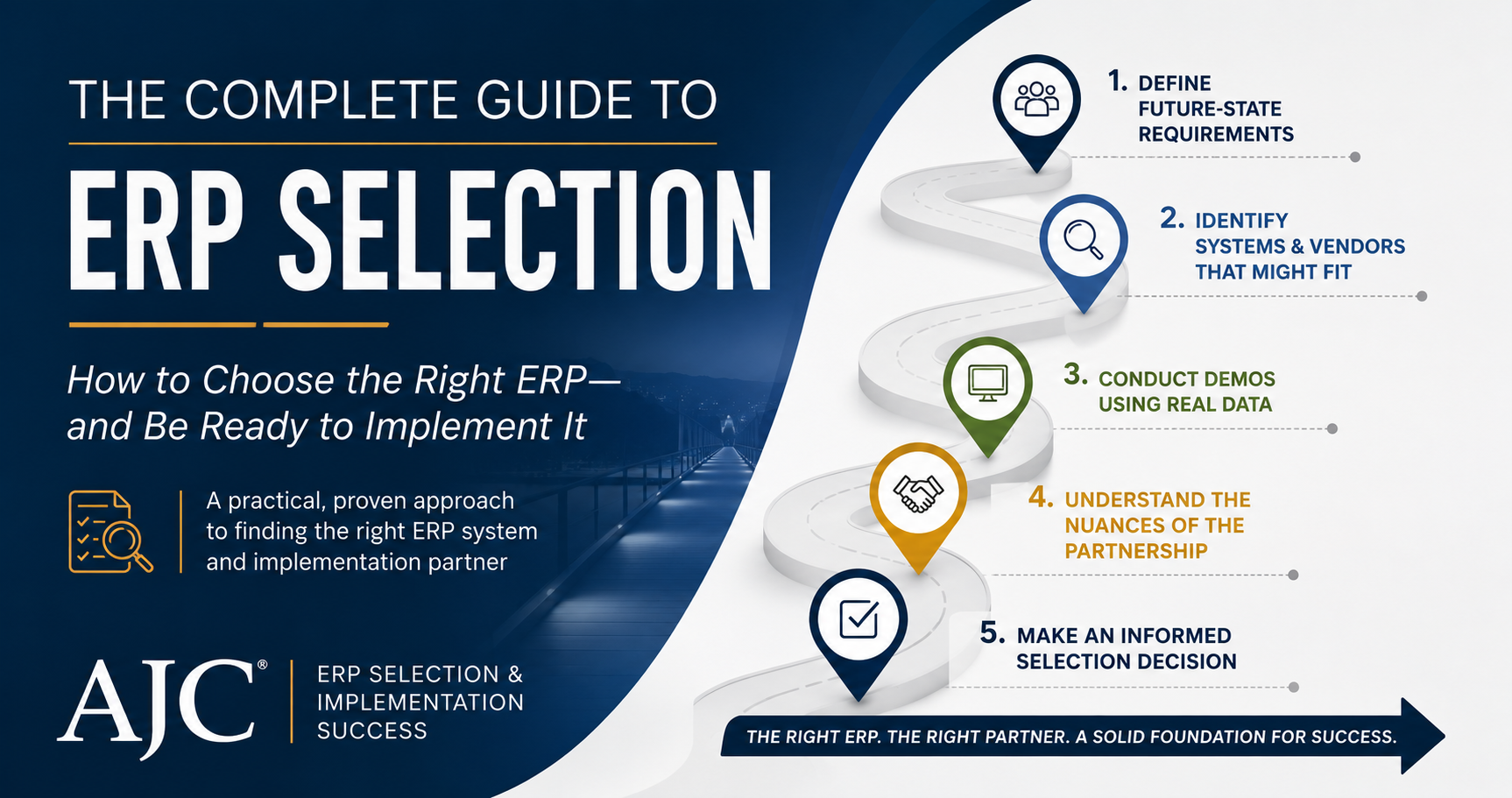
AJC's ERP selection approach can be summarized into five major stages.
1. Define Future-State Requirements
Map critical business processes, understand current pain points, define where the business is going, and identify the requirements the future system needs to support.
2. Identify Systems and Vendors That Might Fit
Research potential ERP systems and implementation partners and screen them against your critical requirements.
Not every system deserves a demo.
Disqualifying poor-fit options early saves everyone time.
3. Conduct Demos Using Real Business Scenarios
Ask viable vendors to demonstrate how their systems would handle your requirements and realistic scenarios.
Don't let the entire evaluation consist of whatever the salesperson happens to enjoy demonstrating.
4. Understand the Nuances of the Partnership
Evaluate the people who will help implement and support the system—not merely the software.
Resolve unanswered questions. Check references. Understand implementation methodology, support, resource availability, commercial terms, and relationship fit.
5. Make an Informed Selection Decision
Compare your finalists using consistent criteria, including:
Critical functionality
Ease of use
Implementation approach
Partner fit
Implementation cost
Ongoing cost
Integration requirements
Customization requirements
Timeline
References
Support
Risks
Future scalability
Then make the decision.
How Many ERP Vendors Should We Evaluate?
There is no magic number, but more is not necessarily better.
Early research may identify many potential systems. The purpose of screening is to narrow that universe before asking your employees to sit through hours of demonstrations.
AJC's traditional selection process researches and screens the market, then uses demonstrations and further diligence to reduce the viable options—ideally reaching a small group of finalists that can be compared meaningfully.
Three serious finalists are far more useful than ten generic sales presentations.
The objective isn't to see every ERP.
It's to confidently determine which solution and partner best fit your organization.
How Should ERP Demos Be Conducted?
Never rely solely on a vendor's standard sales demo.
A polished salesperson can make almost any mature ERP look impressive for 90 minutes.
That's not what you're buying.
You're buying the system your employees will use on a chaotic Tuesday six months after go-live.
Give vendors realistic scenarios based on your critical requirements and ask them to demonstrate those workflows.
For example:
Show us how this order moves from quote through shipment and invoicing.
Show us what happens when the customer changes the order midway through the process.
Show us how inventory transfers between locations.
Show us how this commission is calculated.
Show us what happens when a purchase receipt doesn't match the invoice.
Show us how a manager identifies margin by job, customer, product, or location.
When possible, use realistic or representative data.
And ask:
Is what we're seeing standard functionality, configuration, customization, a third-party application, or something that doesn't exist yet?
Those are five very different answers.
How Do We Know If an ERP Vendor Is Overselling Its Capabilities?
Make the vendor show you.
A vendor saying “yes, we can do that” is not the same as demonstrating it.
Scripted demos help turn claims into evidence.
Document unresolved questions and follow up until you understand the answer.
And be particularly careful with language such as:
“We can accommodate that.”
“Our API can handle it.”
“That's configurable.”
“We've done something similar.”
“That's on the roadmap.”
“Our partner can build that.”
Maybe all of those statements are true.
But before signing a contract, understand exactly what each one means technically, financially, and operationally.
How Do You Compare ERP Systems Objectively?
Use a consistent decision framework.
At minimum, compare:
Critical requirements: What percentage can each system handle in the base product?
Configuration: What requires setup but no custom code?
Customization: What requires changing or extending the software?
Integrations: What other systems need to exchange data with the ERP?
Implementation fees: What will it cost to get the system operating?
Subscription/ongoing fees: What will you pay every year?
Additional applications: What third-party tools or modules are required?
Implementation timeline: How realistic is it?
Implementation resources: Who will actually do the work?
References: Have comparable customers successfully implemented the solution?
Usability: Can your people realistically operate it?
Scalability: Will it support the business you expect to become?
Partnership: Do you trust these people enough to work through a difficult implementation with them?
A scorecard helps keep the decision grounded when the team inevitably encounters a particularly impressive salesperson or shiny feature.
Are We Selecting an ERP System or an Implementation Partner?
Both.
This is one of the most commonly underestimated parts of ERP selection.
Depending on the ERP ecosystem, the company selling, configuring, implementing, and supporting your system may be the software publisher itself—or it may be a Value Added Reseller (VAR) or implementation partner.
The same ERP implemented by two different partners can produce very different experiences.
Evaluate:
Who will actually be assigned to your project?
Where are those people located?
How experienced are they?
Have they worked with companies like yours?
How available are they?
How do they manage projects?
Who owns decisions?
How do they handle change orders?
What happens when the project gets behind?
How do they escalate issues?
Who supports you after go-live?
Can you speak with comparable customers?
Good software with the wrong partner can still become a bad ERP project.
Should the ERP Vendor Drive Our Selection?
The vendor should participate in your selection.
The vendor should not own your selection.
ERP vendors know their products. You need their expertise.
But they are also trying to sell you something.
Your organization—or an independent advisor representing your organization—should control the requirements, evaluation process, demonstrations, comparison criteria, and decision.
AJC does not accept ERP vendor commissions or referral fees.
That independence matters because sometimes the best recommendation is:
Don't buy a new ERP yet.
How Important Are Integrations?
Very.
Integrations can become significant drivers of ERP cost, complexity, schedule, and risk.
Identify important integrations during selection, not after you've signed the ERP contract.
Ask:
Which systems must remain?
What information needs to move between them?
In which direction?
How frequently?
Is there an existing supported connector?
Does integration require middleware?
Who builds it?
Who owns it after go-live?
What happens when either system is upgraded?
What does it cost?
A system that appears inexpensive can become very expensive if your business requires extensive custom integration to make it usable.
What's the Difference Between Configuration and Customization?
Configuration uses capabilities already designed into the software.
Customization changes, extends, or adds to the software to make it behave differently.
Whenever possible, AJC generally recommends minimizing customization.
Customization isn't inherently evil. Some businesses have genuinely differentiating processes that technology should support.
But every customization should earn its keep.
Ask:
Why is this process unique?
Does it create competitive advantage or business value?
Would adopting the ERP's standard process actually hurt us?
What will this customization cost to build, test, maintain, and upgrade?
If extensive customization is necessary just to support your fundamental business model, that's a warning sign that you may be selecting the wrong ERP.
How Should AI Factor Into ERP Selection?
AI belongs in the conversation—but don't let it become a shiny-object contest.
ERP systems remain critical systems of record. AI can increasingly enhance the environment around them through analytics, automation, data cleanup, forecasting, natural-language interfaces, agents, and other capabilities.
During selection, ask vendors what AI functionality:
Exists and is usable today
Is included in your license
Costs extra
Requires your data to leave the ERP
Is still on the roadmap
Has been deployed successfully with actual customers
Also consider whether AI or targeted custom development could solve some of your current problems without requiring an ERP replacement.
The objective is not to buy the ERP with the coolest AI demonstration.
The objective is to create the technology foundation that best supports your business.
How Long Does ERP Selection Take?
For many mid-market companies, approximately five months is a reasonable planning assumption for a structured ERP selection, although complexity can extend the timeline.
AJC commonly works with companies in roughly the $40 million to $400 million revenue range with several locations and a few primary revenue streams. More complex operations, more locations, more business models, or more executives involved in the decision may require additional time.
A typical sequence includes:
Month 1: Preparation, stakeholder alignment, process mapping, future-state thinking, and requirements.
Month 2: Vendor research, screening, initial conversations, and demo preparation.
Months 3–4: Demonstrations, follow-up diligence, scoring, references, and narrowing the field.
Month 5: Final comparison, commercial review, recommendation, executive decision, and contracting.
Can it be faster?
Absolutely.
Can it take longer?
Unfortunately, also absolutely.
The biggest scheduling risk is often not the software vendors.
It's your own team's availability and decision-making speed.
How Much Does ERP Selection Cost?
There is no useful universal number because selection cost depends heavily on company complexity and how much work your internal team can perform.
Potential costs include:
Internal employee time
Project management
Process mapping
Requirements development
Vendor research
Demo coordination
Technical diligence
Contract or legal review
Travel
External ERP selection advisory support
The better question is:
What is the cost of making the wrong ERP decision?
ERP implementation for a mid-market organization can easily represent an investment measured in hundreds of thousands of dollars, before considering employees' time, disruption, opportunity cost, and the long-term consequences of selecting a poor-fit platform.
Selection is the relatively inexpensive moment when you still have the ability to avoid those costs.
Do We Need an ERP Selection Consultant?
Not necessarily.
If your company has someone who:
Understands structured ERP selection,
Can objectively facilitate cross-functional requirements,
Has enough available time,
Can project manage the process,
Knows how to navigate vendors and VARs,
Can keep executives and subject matter experts engaged, and
Has the confidence to challenge both your own team and software vendors,
you may be able to run the selection internally.
Many mid-market companies simply don't have that person available.
That's understandable.
Companies hopefully select a new ERP only every decade or so. There is no particular reason your employees should already be experts at something your organization rarely does.
An outside ERP selection consultant can provide experience, structure, objectivity, vendor navigation, and—perhaps most importantly—someone whose job is to keep the process moving while your employees continue running the business.
Which ERP Should our size Company Choose?
Revenue alone cannot tell you which ERP is right for your company.
This is an important distinction.
Consider three $75 million companies:
One is a distributor with thousands of SKUs and multiple warehouses.
One is a manufacturer with complex bills of materials, scheduling, quality requirements, and shop-floor operations.
One is a project-based contractor managing labor, equipment, subcontractors, purchasing, and job costing.
Their revenues are identical.
Their ERP requirements are not.
Company size does affect the likely ERP universe because it correlates with factors such as transaction volume, user count, organizational complexity, budget, reporting requirements, and scalability.
But ERP fit also depends on:
Industry
Business model
Revenue streams
Number of entities
Number of locations
Geographic footprint
Manufacturing complexity
Distribution complexity
Project/job costing requirements
Inventory
Service operations
Regulatory requirements
Integrations
User count
Growth plans
Acquisition strategy
Internal IT capability
Reporting requirements
Truly differentiating processes
So if someone asks:
“We're a $75 million industrial distributor running an old custom system. What ERP should we buy?”
our answer is:
We don't know yet—and anyone confidently naming the winning ERP without understanding your business doesn't know either.
We can identify a reasonable universe of systems.
But first we need to understand your processes, critical requirements, future state, technology environment, and implementation needs.
Buy your ERP. Don't get sold one.
What Are the Biggest ERP Selection Mistakes?
The most common mistakes are remarkably predictable:
1. Starting with vendors instead of business processes
If you don't know what matters, every demonstration looks impressive.
2. Treating every requirement as equally important
Hundreds of undifferentiated requirements make it harder—not easier—to select.
3. Letting the vendor control the demo
You learn what the vendor wants to show instead of what you need to know.
4. Selecting software while ignoring the implementation partner
You're buying both.
5. Underestimating integrations
They can materially change cost, complexity, and risk.
6. Recreating every existing process in the new ERP
Some of those processes deserve to disappear.
7. Over-customizing
If you're rewriting the software to make it fit, reconsider whether it actually fits.
8. Ignoring internal capacity
Your employees still have jobs. ERP work doesn't magically create extra hours in their week.
9. Selecting based primarily on price
The cheapest license is irrelevant if the total solution becomes expensive to implement and maintain.
10. Treating selection and implementation as separate worlds
The work you do during selection should make implementation easier.
What Should Happen Before We Sign the ERP Contract?
Before signing, make sure you understand:
Software included
User counts and user types
Modules
Subscription fees
Implementation fees
Integration costs
Customization
Data migration responsibilities
Training
Environments
Support
Implementation staffing
Project assumptions
Timeline
Payment schedule
Change-order process
Renewal terms
Contract term
Price increases
Third-party products
Who owns what
What happens if the schedule changes
And make sure important promises made during sales conversations appear in the appropriate written agreement.
A fantastic demo is not a contract.
What's the Difference Between ERP Selection and ERP Implementation?
ERP selection determines what system and partner you should choose.
ERP implementation turns that decision into a working business environment your employees can actually use.
Selection includes activities such as:
Process mapping
Requirements
Vendor research
Demos
Evaluation
References
Cost comparison
Partner diligence
Contract support
Final decision
Implementation includes:
Detailed design
Configuration
Data migration
Integrations
Testing
Training
Change management
Cutover
Go-live
Hypercare
They are different projects—but good selection work creates the foundation for implementation.
How Do We Prepare for ERP Implementation During Selection?
Start building readiness before the contract is signed.
By the end of selection, you should have:
Executive sponsorship
A Core Team
Documented critical processes
Future-state direction
Prioritized requirements
Known integration needs
An initial understanding of data challenges
An implementation partner
Realistic expectations about internal participation
Clear decision-making governance
A Project Manager or a concrete plan for who will fill that role
Do not select the ERP and then discover that nobody has time to implement it.
Do We Need to Clean Our Data Before ERP Implementation?
Yes.
Poor data doesn't become good data because you put it into a better system.
Data migration frequently exposes years of:
Duplicates
Inconsistent naming
Obsolete records
Missing fields
Unclear ownership
Conflicting definitions
Historical workarounds
AI can increasingly help analyze, classify, normalize, and accelerate portions of cleanup.
But AI cannot decide what your organization means by “customer,” which record is authoritative, who owns a field, what history must be retained, or what governance rules the company should follow.
Those remain business decisions.
Start thinking about data earlier than feels necessary.
Your implementation team will thank you later.
How Long Does ERP Implementation Take?
For a mid-market organization, ERP implementation commonly takes several months to more than a year, depending on scope and complexity.
AJC generally advocates an assertive but sustainable pace.
Think of it like running a marathon.
Move too slowly and the project loses momentum, people disengage, business conditions change, and costs accumulate.
Sprint too hard and your Core Team burns out while trying to do ERP work on top of their regular jobs.
The right pace keeps meaningful pressure on decisions and deliverables without pretending your employees suddenly have unlimited capacity.
Factors affecting implementation duration include:
Number of locations
Number of entities
Process complexity
Integrations
Data quality
Customization
Availability of subject matter experts
Vendor resources
Decision speed
Testing
Training
Change readiness
What Happens After Go-Live?
Go-live isn't the finish line.
It's the moment your theoretical ERP becomes a real one.
Most implementations should include a hypercare period immediately after go-live when issues are captured, prioritized, escalated, resolved, retested, and communicated quickly.
You'll also need to monitor adoption.
Are employees using the system correctly?
Are transactions accurate?
Are people reverting to spreadsheets?
Are reports reliable?
Are users confident?
Which processes still need refinement?
A successful ERP implementation is not measured by whether the software turned on.
It's measured by whether the business can operate successfully with it.
The Bottom Line: How Do You Choose the Right ERP?
If you remember nothing else from this guide, remember these five things:
1. Understand your business before evaluating software.
Map your critical current-state processes and define where the business needs to go.
2. Prioritize what truly matters.
Separate genuine must-haves from features that would simply be nice.
3. Make vendors prove the fit.
Use realistic scenarios and consistent evaluation criteria.
4. Select the partner as carefully as the software.
The people implementing the ERP can dramatically affect the result.
5. Prepare for implementation while you're selecting.
Your Core Team, processes, requirements, data, governance, and project leadership are part of ERP readiness.
ERP selection is not fundamentally a software-shopping exercise.
It is a business decision about how your company will operate for years to come.
Take enough time to understand the business.
Then buy your ERP.
Don't get sold one.
Want to Do It Yourself? Start Here.
You absolutely can.
Before beginning, make sure you have:
A strong Executive Sponsor
A designated ERP Selection Project Manager
A cross-functional Core Team
Time reserved for process mapping
Documented current-state pain points
A defined future-state direction
Prioritized critical requirements
A vendor screening process
Scripted demo scenarios
A consistent ERP comparison scorecard
A plan for reference checks
A total-cost comparison
A process for evaluating the implementation partner
A clear decision date
A realistic implementation-readiness plan
If you have the internal experience and available time to run this process, use this guide and get started.
If you don't, that's exactly the problem AJC® solves.
We help companies understand their operations, define what they actually need, navigate the ERP market, evaluate systems and implementation partners objectively, and drive the selection to a decision.
We do not sell ERP software.
We do not accept commissions or vendor kickbacks.